


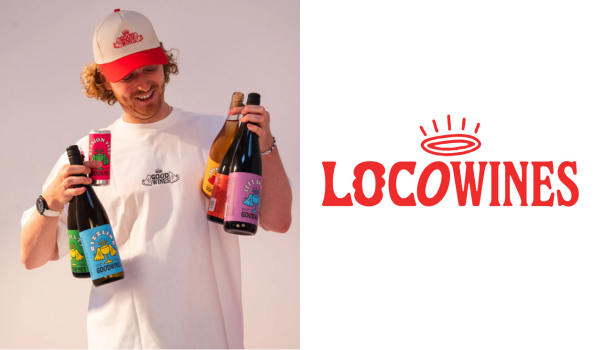
When Harri Holroyd first started thinking about Loco Wines, he was trying to solve a simple problem.
“If you go to a festival or a food and drink event, you have a billion different craft beers to choose from. The wines are literally the worst options ever and they are super expensive.”
That frustration, combined with a trip to Barcelona and a passing rubbish truck that “looked really cool”, sparked an idea. What if wine could show up in places it usually did not, and feel less intimidating when it did?
“We thought, how cool would that be if it was a wine truck?”
That idea turned into a converted 1960s caravan, subscription boxes that helped fund the build, and a lot of hands-on learning along the way. It was never meant to be a perfectly planned FMCG launch.
As Loco Wines evolved, Harri and the team realised that if they wanted to change how people thought about wine, they needed more than a good product.
“If we ever wanted to make a big deal of it, we knew we needed to have a brand. At the very start, we were basically just a wine wholesaler.”
The rebrand to Loco Wines was deliberately simple. The name was chosen to strip away jargon and intimidation.
“Loco Wines does what it says on the tin. It rips the mystery away.”
But launching a brand and building a retail-ready FMCG business are two very different things.
“I was working on the brand by myself. I didn’t really have anyone to speak to about it. The people I asked for advice had never worked in FMCG. And FMCG is its own beast.”
When Loco Wines was still early, the brand had momentum, but much of what came next felt unfamiliar.
“I went into it relatively blind. I didn’t really know what I should be expecting, I just knew I didn’t have people around me who understood FMCG.”
At the time, Harri was building the business largely on his own.
“I was working on the brand by myself, and that gets quite lonely quite quickly.”
Joining the YF Starter Programme made a huge difference, giving him perspective and somewhere to sense-check ideas.
“Just having people there who are in the same position as you, who you can ask stupid questions or sanity-check decisions with, was something I didn’t have before.”
That support created space to step back and think more clearly.
“You can be so deep in ops or numbers that you don’t really stop. It gives you a moment to lift your head up and ask, what have I actually done this week? What do I need to focus on next?”
It also helped normalise the experience of building an early-stage FMCG brand.
“Everyone has the exact same problems. You realise it’s not just you.”
As Loco Wines moved closer to retail conversations, the weight of each decision increased.
“You realise quite quickly that small choices around pricing, positioning or pitch can have big knock-on effects.”
Seeing how others approached those moments helped sharpen Harri’s own thinking.
“It’s so easy to go into a retailer without ever having seen what a pitch should look like. Watching other people, you start to understand what’s missing from yours.”
Understanding the commercial reality behind those conversations reduced hesitation.
“It helps you understand what actually happens once you’re on shelf, rather than guessing.”
Over time, that clarity built confidence.
“It kind of pierces the FMCG veil. You feel more confident making decisions instead of second-guessing everything.”
That shift went beyond individual decisions.
“We’re better at knowing our worth now. We don’t look at it like people working with us are doing us a favour anymore.”
Loco Wines launched in August and has already built strong off-trade momentum. The plan now is national expansion.
“By March, Loco Wines should theoretically be nationwide.”
As the business grows, having the right support around key decisions continues to matter.
“YF is helping us make sure we are not just on shelf, but on shelf in the right place, with the right look and the right value proposition.”

“When the money leaves the account, you do think, is this worth it? But you will one hundred percent make that money back in what you learn from YF.”
For Harri, the biggest lesson is about momentum.
“The longer you wait, the harder it gets. Just start. You can refine along the way. Starting is the hardest part.”
If you have created a FMCG brand and want to reach your first £10k month in sales, find out more about the Starter Programme and how to apply here.
Subscribe to our mailing list to stay in touch with the latest news, insights and updates from YF.
Subscribe today to keep informed of any important industry news and exclusive insights on how you can scale and strengthen your business.
Our Preferred Suppliers are a selection of businesses that we have vetted and trust to recommend to our brands. We have negotiated discounts or deals with many of them.
Access to the list and discounts is a benefit to Community members only.
Not a member yet? Find out more here